24 October 2026

Dry Bulk Shipping 2025: Serious Troubles Ahead!
The global dry bulk shipping faces an uncertain future as it deals with trade war, market volatility, geopolitical tensions and low fleet growth.

The global dry bulk shipping market is heading into an uncertain 2025, grappling with a range of concerning challenges. From geopolitical tensions and Houthi rebel attacks in the Red Sea to market volatility and sluggish trade activity, the industry faces mounting pressure.
Demand growth is projected to stagnate—potentially falling to 0% or even declining in certain segments—while fleet expansion continues, with the supramax and ultramax fleet expected to grow by up to 5%. This imbalance between supply and demand, combined with ongoing disruptions and low fleet utilization, paints a cautious outlook for the sector.
Table of Contents
The impact of the current trade war and market volatility
Used mainly to transport commodities such as grain, bauxite, coal, iron ore, etc., the international dry bulk shipping accounts for about 43% of the total capacity of the global fleet. However, the current trade war triggered by the U.S. tariffs on other countries like China, Canada, EU and the counter-tariffs from those nations are creating uncertainty and volatility in the market, which is drastically affecting trade flows in a negative way.
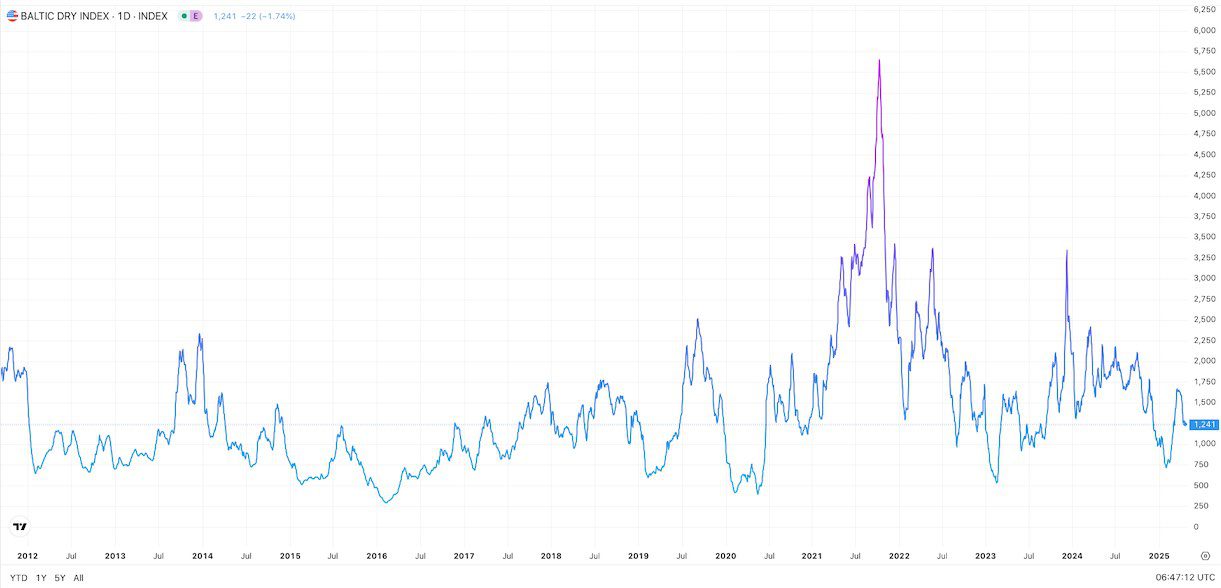
Between March and April 2025, the Baltic Dry Index (BDI) monthly indicator, which traditionally measures the Dry Bulk Shipping rates, dropped by as much as 21%, indicating a sharp decline in demand for dry bulk shipping, possibly worsened by the current trade tensions.
The Baltic Dry Index (BDI) indicates a sharp decline in international dry bulk shipping (years till date), April 2025.
The tariffs have caused a significant slowdown in agriculture and raw material shipments. In particular, by switching its soybean imports from the U.S. to Brazil, China is changing traditional trade routes and, being a big importer, creating pressure for ports’ management along the new routes.
Despite having a strong performance in 2020-2021, the international dry bulk shipping rates were normalised moderately in 2023, but the sector is now facing a troubling decline in demand.
How Trump’s Trade War Can Stymie the Shipping Industry in 2025
President Trump’s tariffs on goods imported from China (20%), the European Union and others are estimated to affect well over $1 trillion worth of goods being moved by U.S. trading partners.
Ship Nerd
Low fleet growth (Time chartering)
Following the moderate performance in 2023 post-pandemic and the apparent fluctuations in demand in 2024-2025, the trend in the global dry bulk shipping reflects shipowners’ reluctance to invest heavily in fleet expansion. Another important factor that is preventing shipowners or operators from spending their money on newbuilding orders is the higher costs of construction.
To construct new vessels that comply with IMO emission standards and other fuel-efficiency guidelines, shippers will be required to spend roughly $25- $35 million to acquire a Handysize vessel (30,000-40,000DWT), $30-$40 million for a Supramax (50,000-60,000 DWT), $35-$50 million for a Panamax (65,000-80,000 DWT), and a Capesize (120,000+ DWT) costs about $60 million or more.
With very few new vessels (slow supply) and moderate demand, dry bulk shipping carriers mostly see stability in time chartering rates. Therefore, a large percentage of dry bulk shipping companies are now engaging in time chartering, because it makes more business sense as the demand for larger vessels like Capesize has dwindled in the past years.
Houthi rebels, piracy, and other geopolitical risks
Since October 2023, there have been more than 200 Houthi attacks on ships passing through the Suez Canal, which holds about 30% of global container traffic, making the Red Sea and Gulf of Aden very volatile and threatening global maritime operations. On record, the international trade through the Suez Canal dropped by as much as 50% in the first two months of 2024, compared with the first two months of 2023. [2]
Unlike Somali pirates that sometimes hijack vessels purely for financial gains (to collect ransoms), Houthi rebels’ actions are politically motivated, better planned, and more disruptive as they target vessels from countries or shipping companies that are associated with Israel, utilizing sophisticated weaponry. Due to Houthi rebels’ attacks, the international shipping industry is being confronted with higher insurance premiums and security expenses.
On separate occasions, the US and UK have launched military offensives against the Houthis, with the US spending about $ 1 billion in a recent 3-week military campaign. To avoid being attacked, many shippers are now rerouting their vessels around Southern Africa, facing longer routes and more expensive operational costs.

2 Houthi Missiles Hit Another Greek Bulk Carrier
A Star Bulk vessel became the latest Houthi target today when it was shot twice in 20 minutes by missiles while transiting in a southeast direction.
Ship Nerd
Regulatory concerns
Operators of international dry bulk shipping are strategically avoiding investing in old tonnage because of the prevailing regulations that demand transitioning into fuel-efficient and emission-free shipping operations.
Dry bulk shipping operators are expected to pay attention to the following aspects of regulations guiding their day-to-day activities so as to become fully compliant:
- Safety and Inspection Standards: RightShip’s RISQ Programme requires that operators of dry bulk shipping undertake consistent inspections of their vessels in order to reduce their rates of accidents and fatalities that are usually higher with bulk carriers when compared with other categories of ships.
- Environmental Regulations: The International Maritime Organization (IMO) has a list of guidelines and recommendations urging shippers to embrace alternative, more-efficient fuels in their decarbonization efforts. This may require implementing efficient-fuel updates on the existing vessels, such as engine retrofitting.
- Port State Control (PSC): In its bid to encourage full compliance, the PSC located in various ports around the globe is putting pressure on dry bulk shipowners to consistently undertake the inspection of their ships and obtain the necessary certifications.
- DryBMS (Dry Bulk Management Standard) Framework: This framework streamlines compliance for dry bulk shippers and improves their safety management approaches.
Newbuilding orders overload: Orderbook is full
As indicated by the Baltic Dry Index (BDI), which fell in April 2025, the dry bulk shipping market is cooling. Even though the newbuilding orders are overloaded or the orderbook is full, in Q1 2025, newbuild orders for dry bulk ships declined by 26% year-on-year, indicating that the sector is not inured to the prevailing trade war and global economic uncertainty. [3]
Historically, the current orderbook-to-fleet ratio can be considered high, most especially in the orders for Ultramax (28.6%), Kamsarmax (21.7%), and Newcastlemax (19.8%) categories. This significant increase in orders since 2023 translates into 541 bulk carriers that should be delivered in 2025—the highest count in the sector since 2016!
However, conditions such as weak freight rates, long lead times, and high construction prices are compelling shipowners to consider purchasing second-hand ships, leading to five-year-old vessels now going for about 86% of the value of a newbuild. In the same fashion, the second-hand market also experienced price reduction across ship classes, with the price tag for five-year-old Capesize ships declining by 11%, Panamax by 12%, and Supramax and Handysize by 9%. [4]
Key Takeaways
To achieve stability in their routine shipping operations, operators of international dry bulk vessels need to come up with a contingency plan that will help them mitigate the ever-increasing risks and challenges confronting their businesses.
See Also

Why Kamsarmax Vessels Are Now Prefered By Shippers Globally
Kamsarmax vessels are recently being preferred from many shippers worldwide because of their comparative efficiency, performance, and ROI.