24 October 2026

Sharp Decline in Cargo Volumes Projected for 2025
The Port of Los Angeles faces a 10% drop in its cargo volume in 2025; while at Singapore, Rotterdam, and Shanghai volumes are declining equally!

The Port of Los Angeles faces about a 10% drop in its cargo volume for the rest of 2025; the Port of Singapore (up to a 3% decrease is expected); the cargo volumes handled at the Port of Rotterdam and the Port of Shanghai respectively are declining equally!
Table of Contents
The Port of Los Angeles
Despite having a strong first-quarter performance in 2025, the Port of Los Angeles—the U.S.’s busiest container port—is gearing up for a drastic decline in its cargo volume for the remainder of the year. The port reportedly handled over 2.5 million TEUs between January and April 2025.
However, the overall numbers are not looking quite encouraging for the Port. In March 2025, post-tariffs, the Port of Los Angeles’s loaded imports were estimated to be 385,531 TEUs, which was 1.6% higher than the volume in March 2024, but there was a 15% decline in loaded exports, calculated to be 122,975 TEUs. In total, the Port processed about 269,900 empty containers, representing roughly 23% higher when compared with March 2024. [1]
Even Gene Seroka, the Port of Los Angeles Executive Director, is not hopeful about the situation.
“Our volume remained strong throughout the first quarter, and we’ve now seen year-over year growth in 18 of the last 20 months. However, with tariff and counter tariffs dominating the news, I expect we’ll see cargo decline in the second half of the year at least 10% compared to 2024,”
Gene Seroka, Executive Director, Port of Los Angeles
The Port of Rotterdam
The Port of Rotterdam experienced a marginal decline in cargo volume throughput in 2024, compared to 2023. The Port’s breakbulk section reportedly plunged by 3.7 per cent and, owing to lower throughput of non-ferrous (non-iron) products and steel as result of poor demand from European industry and sanctions on Russian aluminium, other breakbulk likewise tumbled by 10 per cent.
In a similar vein, the liquid bulk category dropped by 2.7 per cent, to approximately 200 million tonnes. Due to the refinery maintenance in Rotterdam and the nearby areas, crude oil throughput slumped by 4.5 per cent to 97.8 million tonnes. The same negative trend is noticeable in diesel and LNG throughput; the LNG throughput reportedly dropped by as much as 5.3 per cent. And the throughput of other liquid bulk was made to drop by 2.2 per cent due to the decline in renewable fuel capacity.
Boudewijn Siemons, CEO of the Port of Rotterdam Authority, remarked.
“Last year, we found ourselves as a stable port in turbulent international waters. Geopolitical tensions and regional conflicts impacted the global economy, leading to market uncertainty.”
Boudewijn Siemons, CEO, Port of Rotterdam Authority
It is expected that the new wave of U.S. tariffs and counter-tariffs will definitely slow down some operations at the Port of Rotterdam. [2]

Free shore power from battery in Port of Rotterdam
Free shore power is available at Maaskade in Rotterdam for large inland vessels that are in a trial with shore power from a battery system.
Ship Nerd
The Port of Singapore
Despite being a long-time U.S. trade partner, and slammed with a small 10% baseline U.S. tariffs, Singapore is preparing itself for a low export quantityin 2025—an issue that can cause a dramatic decline in its overall shipments/cargo volume this year.
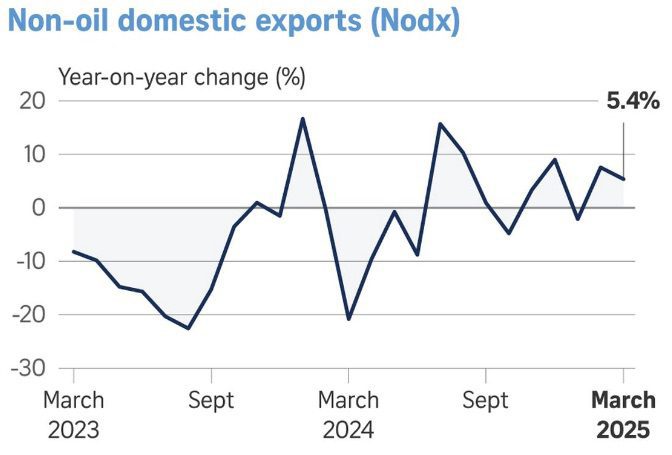
The Enterprise Singapore, a governmental agency that monitors the growth and internationalization of Singaporean businessed, revealed in its March data for non-oil domestic exports (Nodx) on April 17, 2025, that even though shipments in March rose 5.4 per cent year on year, it was still worse than projected and lower than the 7.5 per cent increase achieved in February, 2025. Some experts polled by Reuters had expected a sizeable growth of 14.1 per cent. Therefore, Singapore’s non-oil export is projected by analysts to shrink by as much as 3%, affecting primarily products such as electronics, semicondutors, and pharmaceuticals.
The Port of Shanghai
In 2018, China accounts for about 37% of all U.S. containerized imports, but over the years that figure has whittled down to just 30%. With the crippling 145% tariffs recently imposed on Chinese products by the Trump Administration, it is clear that U.S. importers will find affordable alternatives to Chinese merchandise.
As the trade war persists, several U.S. importers have canceled their previously reserved freight ships out of China. It was reported that the freight company, HLS Group, has already recorded about 80 blank or canceled sailings out of China. These ensuing decreases in Chinese freight bookings are affecting the shipment of different categories of products like apparel and accessories, textiles, wool, and fabrics from China, all of which were reportedly down over 50%. Other containerized Chinese merchandise that are equally affected by the high U.S. tariffs are toys, sport equipment, and furniture.
It is evident that the container traffic from China to North America is in a precarious situation right now, and this may have a long-time impact on the supply chain and the economies of the two warring nations—the United States and China.
Shipments to the ports of Los Angeles and Long Beach
Daily short-term rates for 40-foot equivalent units to the U.S. from China and Vietnam | Jan. 15–April 17, 2025

Some potential measures to address these serious ports’ declines
It is undeniable that the global maritime industry is currently under intense financial pressure as a result of the ongoing trade war. This calls for across-the-board risk mitigation procedures to prevent this dire situation from degenerating further into a complete meltdown of shipping activities, as China and the U.S. show no signs of reaching any trade agreements soon.
It may be necessary for governments, local shipping agencies, and associations of shippers to collaborate in the following ways to address this problematic issue of decline in global cargo volumes:
- Crisis management: This may require coming up with a contigency plan to identify areas that need immediate strengthening in order to avoid a total collapse of shipping operations at those affected ports.
- Expanding trade partnerships: Countries are now forming new trade partnerships to find larger markets for their products. In particular, China and the European Union are warming up to each other to establish a win-win trade alliance. This approach may create new, busy routes for shippers.
- Diversifying the handling of cargo volumes: Shipping companies may need to expand their operations into other categories that may not be directly affected by the disrupting tariffs, such as breakbulk, liquid bulk, and specialized cargo volumes. This will help reduce absolute dependence on container traffic. Other options is to create new multi-modal transport hubs that can seamlessly support the integration of road, rail, and maritime logistics to cut transportation costs.
- Financial lifeline: Some shippers have already been asking their governments for some kinds of financial lifelines to survive the current cargo volume declines. This may come in the form of a stimulus, loan, reduction in taxes, or tax credits for green-energy utilization.
Takeaways
Governments, local shipping agencies, and international maritime organizations should promptly set up systems to help cushion the ongoing financial pressure shippers are unfortunately exposed to during this global trade turmoil and decline of cargo volumes.
See Also
How Trump’s Tariffs Can Stymie the Shipping Industry in 2025
President Trump’s tariffs on goods imported from China (20%), the European Union and others are estimated to affect well over $1 trillion worth of goods being moved by U.S. trading partners.