25 October 2026

How AI-Based Container Inspection Could Eradicate the Exports of Counterfeited & Stolen Goods
Ever wondered how AI-assisted container inspections may bring an end to the era of counterfeited goods shipment once and for all?
Contraband shipment is a recurrent logistical problem that shippers deal with. However, AI-assisted container inspections may bring an end to the era of counterfeited goods shipment. To Summarize:
The Perennial Problems of Shipping Stolen and Counterfeited Goods: The criminal activity of shipping counterfeited and stolen goods has caused several legitimate businesses to incur massive revenue losses, face stiff competition for market share, and struggle with maintaining their existing supply chains. It also exposes consumers to harmful and substandard goods, causing nations to lose a lot of money due to tax evasion, and increasing funding for terrorist or criminal activities.
How AI-based Systems Can Revolutionize Container Inspections: The application of Artificial Intelligence (AI) in container inspections has brought about certain excitement in the maritime industry. The newly developed AI-assisted cargo-inspecting devices are reportedly better, faster, and more accurate than the traditional 2D imaging systems in the sense that they utilize deep learning algorithms to properly identify anomalies related to counterfeited goods in real time, and are normally compatible with other databases.
The Major Challenges Confronting the Use of AI in Cargo Inspection: There are some existing constraints that make the full adoption of AI in cargo inspection impossible at this moment, and they include a lack of personnel, system upgrades, scalability, evolving legal support, etc.
Table of Contents
The Perennial Problems of Shipping Stolen & Counterfeited Goods
In 2019 alone, the financial cost of global illicit trade in counterfeit and pirated goods was estimated to be about USD 464 billion, representing almost 2.5% of the world trade that year. This criminal activity has caused several legitimate businesses to incur massive revenue losses, face stiff competition for market share, and struggle with maintaining their existing supply chains. The most dangerous aspects of trading in counterfeited and pirated goods are that it exposes consumers to harmful and substandard goods, causing nations to lose a lot of money due to tax evasions, and increasing funding for terrorist or criminal activities as smugglers use the proceeds made from shipping and trading in illicit goods to commit heinous crimes. [1], [2]
How AI-based Systems Can Revolutionize Container Inspections
The application of Artificial Intelligence (AI) in container inspections has brought about certain excitement in the maritime industry as it holds the magical wand, so to speak, that can help shippers drastically reduce or eliminate counterfeited goods from the supply chains. Several port authorities and managers are now implementing the following procedures to keep pirated goods from their cargoes.
1. Using AI to Analyze X-Ray Scanning
Utilizing AI to analyze containers’ x-ray scanned images can benefit shippers in various ways. In addition to ensuring accuracy and speed, it can also help shippers discover patterns in counterfeited goods shipments. It can equally streamline cargo verifications (pre-shipment and compliance), whereby scanned images and sensor data are compared to determine the differences between original goods and their pirated counterparts.
The newly developed AI-assisted cargo-inspecting devices are reportedly better than the traditional 2D imaging systems in the sense that they incorporate deep learning algorithms to properly identify anomalies in the x-ray images that are indicative of being a counterfeited good.
2. Real-time Processing & Prompt Decision-Making
AI has the capability to quickly analyze, process, and interpret data that shippers can utilize in making quick decisions so as to identify any pirated or counterfeited goods within seconds or minutes. Hence, by utilizing machine-learning models, the decision-making process is being automated, and shippers can immediately call for cargo re-inspections when some of their containers are flagged.
3. Compatibility with Law Enforcement Databases
More importantly, because the AI models applied at several ports are compatible with other systems/devices, data can be shared among different agencies, customs, border security, and law enforcement agents in real time to reduce smuggling and shipment of contrabands. [3]
4. Undertaking Automated & On-the-Go Risk Assessments
The good news is that the entire process of scanning (or imaging), image analysis, interpretation, and reporting can be fully automated. This provides shippers with the unique opportunity to have historical data handy that they can use in periodically analyzing the current or future flagged items.
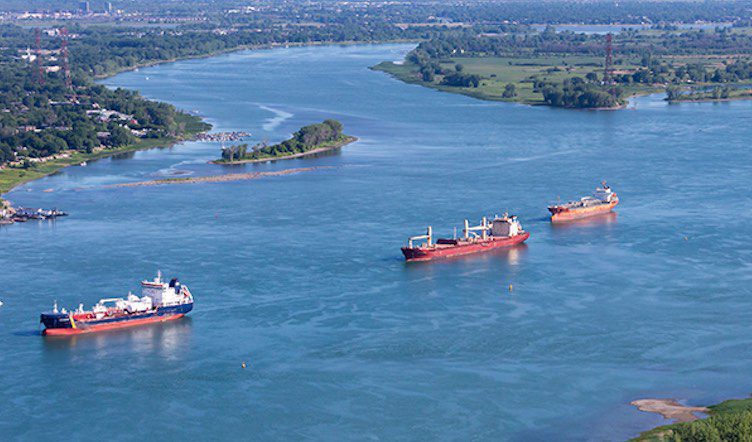
AI Technology to Measure and Reduce the Carbon Footprint of Vessels
The Montreal Port Authority (MPA) and GSTS, launched a new project to measure and reduce the carbon footprint of vessels using AI Technology.
Ship Nerd
The Major Challenges Confronting the Use of AI in Cargo Inspection
There are some existing constraints that make the full adoption of AI in cargo inspection impossible at this moment, and they include the following factors:
1. Lack of Personnel
It is a fact that many port workers and managers still lack the functional knowledge of AI systems and how the technology can be put to good use for inspecting cargos. This will require that port workers and managers are properly and routinely trained to be able to handle the operation, and this may take some time and require some investment.
2. Scalability
Building AI models for cargo inspection is currently expensive, and it may not be scalable for all ports, especially small ports that cannot afford huge investments in the systems.
3. System Upgrade
It may be necessary to upgrade or reprogram some existing port systems that will be integrated with AI. The newly programmed AI models must be periodically updated and trained to remove biases and enhance accuracy. For example, it may be considered unethical for AI-supported scanners to consistently flag goods emanating from countries that are traditionally known for producing the largest quantity of contrabands, even when the goods being flagged are original.
4. Evolving Legal Support
It may be surprising to assert that some countries still impose certain restrictions on AI applications, for fear of not being used ethically. In this scenario, it is imperative that a global consensus is reached on how AI can be legally incorporated into container screening to ensure safety and better performance in the marine industry. Connecting automated AI scanners to the world’s law-enforcement databases and port agencies’ systems can ensure that all legal or regulatory protocols have been duly observed. [4]
Key Takeaways
Shipping pirated goods causes logistical hassles for shippers and may affect their reputation and overall performance. Hence, the advent of AI-assisted container inspection will not only streamline pre-shipment and compliance verifications, but it will also help shipping companies avoid huge fines associated with transporting counterfeited goods.
See Also

Smart Shipping: 5 Significant Digital Transformations
Smart Shipping encompasses genuine adoption of AI-driven logistics, digitalizing maritime operations, constructing autonomous vessels etc.