25 October 2026

Shaft Generators: The Next Step in Ship Efficiency Improvement
Shaft generators offer shipowners the unique opportunity to save on energy or fuel expenses while prolonging the longevity of their vessels’ engines

Background: The concept of shaft generators (or a.c. alternators) first emerged in the 1960s as one of the viable alternatives for generating clean and emission-free energy for shipboard systems and equipment.
Working Principles: Shaft generators have three main modes of operation, namely PTO (Power Take Out), PTI (Power Take In), and PTH (Power Take Home).
Current Applications: There are currently two significant applications of shaft generators in the marine industry: In newbuildings and retrofits.
Why Shaft Generator Getting More Popular? The recent spike in the popularity of shaft generating systems in the marine industry is directly linked to the technology being perceived as a valuable, economical, and cleaner energy solution by shipowners.
Further Developments: As promising as the shaft generating systems are, the technology still needs some improvements.
Table of Contents
Background
The concept of shaft generators (or A.C. alternators) first emerged in the 1960s as one of the viable alternatives for generating clean and emission-free energy for shipboard systems and equipment. The mechanics of shaft generators is very simple when it was first developed: the vessels’ main engines were connected to propeller shafts, and as the engines rotated the propeller shafts, mechanical energy was consequently converted into electrical energy. When compared with fuel-based generator sets (gensets), shaft generators can save fuel by as much as 3-7 per cent. In other words, unlike gensets, shaft generators don’t use diesel or kerosene, and they don’t produce emissions, thereby supporting strict compliance with EEDI and EEXI regulations.
Since its invention, the shaft generator has been used on naval vessels, tankers, large commercial ships, cargo ships, and bulk carriers. For military vessels, shaft generators have helped generate power for emergency purposes; for tankers, shaft generators were used for pumping operations and onboard electrical systems, while they were mostly used to generate enough electricity to power hotels and shipboard systems in passenger and cruise vessels. [1]
Working Principles
To fully understand the principles behind shaft generators, it is important to take a critical look at their design. Every shaft generator comprises of two bearing alternators that are connected to the ship’s main engine to generate electric power. There is also a gearbox, a cooling system, a coupling device that connects the shafts to the ship’s engines, a frequency converter, and a control system.
Shaft generators have three main modes of operation, namely PTO (Power Take Out), PTI (Power Take In), and PTH (Power Take Home).
PTO (Power Take Out)
In this mode, the shaft generator operates as an alternator, and it is primarily driven by the main propulsion engine. In this case, the shaft generator is solely responsible for generating the power supply required for the ship’s entire electrical systems.
PTI (Power Take In)
When operating in Power Take In (PTI) mode, the shaft generator merely functions as a synchronous motor, because the main electrical power is being generated by the vessels’ supporting diesel gensets. In this condition, the shaft generators can act as a power boost, allowing the main engine to reduce its fuel consumption while increasing the vessel speed and protecting the main engine from wear.
Therefore, in this circumstance, the shaft generator doesn’t necessarily need a self-starting feature or functionality because it is already rotating as an alternator before transitioning into motor mode.
PTH (Power Take Home)
Like PTI, in PTH mode, the shaft generator operates as a synchronous motor alongside fuel-powered motor. But the major difference is that, this time around, the shaft generator is mainly responsible for generating 100% of the vessel’s propulsion power. This can occur in an emergency scenario whereby the main engine suddenly suffers a failure or seriously requires an unplanned maintenance.
For some vessels, this may be their usual or normal power-generating approach. At times, a ship’s main engine may require routine maintenance or be stopped while arriving at a port. In this case, the PTH mode is the most preferred method to power a vessel’s onboard systems and electrical requirements. Unlike PTI mode of operation, in PTH mode, a self-starting functionality is required to jumpstart a motor from zero speed.
These are the different types of self-starting techniques often utilized in PTH mode: [2]
- Pony Motor Start: To achieve the synchronous speed, the shaft of the shaft generator is physically connected to and brought up to speed by an auxiliary but smaller electric motor that disengages as soon as the shaft starts rotating at its normal speed.
- Auto-Transformer Start: As its name implies, this process requires using an auto-transformer to reduce the amount of voltage supplied to the shaft generator’s main terminals, allowing only the adequate amount of inrush currents capable of producing the necessary breakaway torque and turn the shaft generator’s shaft.
- Excitation controlled start (single propeller): The excitation controlled start involves two systems—single propeller and twin propeller systems. For the single-propeller start; to limit or regulate the inrush currents, it is necessary to utilize a Stator Current limiting feature in the auxiliary generators’ AVRs. Automatic Voltage Regulators (AVRs) help ensure efficient power delivery in marine propulsion systems by regulating torque and power delivery.
- Excitation controlled start (twin propeller): This starting approach is similar to the one described above (3) but the only difference is that the vessel has twin propellers, two shaft machines, and twin main engines. And the Stator Current limiting feature is present on each shaft machine, making it possible for one shaft machine (that is operating in PTO mode) to start the second machine (that is operating in PTI/PTH mode).
- Variable Frequency Drive (VFD) Start: For a VFD start, the generator shaft is slowly rotated by the VFD, limiting the current until the correct amount of shaft torque is provided. This continues until the synchronous speed is attained. It is possible to also start the shaft generator as a synchronous motor.
https://www.stamford-avk.com/sites/stamfordavk/files/AGN039_C.pdf (nice graphics in this reference)
Current Applications
There are currently two significant applications of shaft generators in the marine industry:
Newbuildings
Shipbuilders are now integrating shaft generators into their newbuilds as Power Take-Off (PTO) systems to achieve considerable savings on energy and meet the necessary fuel/energy regulations. To ensure fuel sustainability and efficacy, some new vessels have incorporated hybrid propulsion systems into their vessels.
Retrofits
In 2023, Wärtsilä completed the first-ever inline shaft generator retrofit on the bulk carrier Berge Toubkal, thereby improving its Energy Efficiency Existing Ship Index (EEXI) and reducing reliance on auxiliary engines (A/E). In addition to enhancing energy efficiency, it equally facilitates meeting IMO decarbonization requirements.
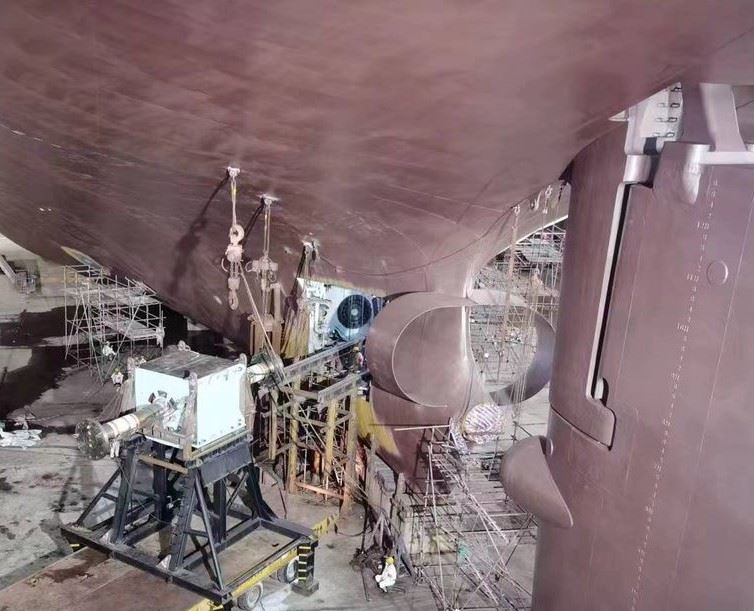
First Inline Shaft Generator Retrofit for the Maritime Industry
Wärtsilä has successfully completed an inline shaft generator retrofit on the ‘Berge Toubkal’, a cape-size bulk carrier owned by Singapore-based Berge Bulk.
Ship Nerd
A well-known retrofit is the Shanghai Marine Diesel Engine Research Institute (SMDERI) Shaft Generator that has remained a trusted, clean-energy solution since 2007, with more than 200 applications worldwide. The SMDERI Shaft Generators enhance energy efficiency for both the existing and newbuildings, exhibiting the following characteristics: EPL up to 10%; EEXI up to 12%; EEDI up to 5%; and CII up to 5%.
A SMDERI shaft generator can be mounted directly on the intermediate shaft because of its no-bearing design and a peculiar split-half structure. With SMDERI shaft generator, it is unnecessary to replace the ship’s shaft system. The split arrangements let SMDERI shaft generator avoid the ship’s Dry Docking and subsequently cut down the installation period to just 9 days while floating at any berth.

Why Shaft Generators Getting More Popular?
The recent spike in the popularity of shaft generating systems in the marine industry is directly linked to the technology being perceived as a valuable, economical, and cleaner energy solution by shipowners.
Some vessels are already ahead by implementing their first stage of improvement retrofits. This includes integrating Hydrodynamic Energy Saving Devices (ESDs), which utilized the shaft generating setup.
For example, tankers usually require a big electric load due to their Ballast Water Treatment Systems (BWTS) and Exhaust Gas Cleaning Systems (EGCS). However, with the integration of shaft generators, those tankers won’t ever need to depend on all 3 auxiliary engines to generate enough power for their sea voyages. [3], [4]
Further Developments
As promising as the shaft generating systems are, the technology still needs some improvements.
Although the technology has changed from simple, fixed-speed generators to more advanced variable-speed models, it still needs to perfect its hybrid engine propulsion system.
One of the newest developments in shaft generator technology is its direct connection to the main engine’s crankshaft. This upgrade is not perfect yet, but it removes some operational difficulties such as the burdensome stern mounting and downtime and increasing operational costs for servicing and maintaining shaft generators. Shaft generators’ design also needs to be more compact, and the technology should be modified in order to smoothly supply power to ship engine’s air lubricator. [5], [6]
Key Takeaways
The use of shaft generators can help shipping companies and shipowners meet IMO requirements while implementing this economical form of energy to usually keep their vessels operational on the sea.
See Also

Alternative Fuels Availability for Shipping Industry in 2025
What are the available alternative fuels in 2025? Are shippers determined to reduce GHG emissions to meet their decarbonization goals?