24 October 2026

Developments of Nuclear Energy in Shipping Now
Nuclear energy has been touted as a viable catalyst for decarbonization in the maritime industry. Get in line with the current developments?

Utilizing nuclear energy for shipping operations has been touted as a viable catalyst for attaining decarbonization in the maritime industry, and there is a brief overview of the current developments:
- The Concept of Floating Nuclear Power Plants (FNPPs) are power barges that can be moored at coastal locations or ports, providing clean and stable energy for powering maritime activities.
- Miniature Small Modular Reactors (SMRs) are a mini version of SMRs, usually compact and scalable, having a capacity up to 300 MW(e) per unit, mostly useful for generating zero-emission power for shipping operations.
- Molten Salt Reactors (MSRs), a kind of nuclear fission reactor that uses a molten salt mixture as the coolant and fuel. They dissolve fissile materials like uranium-235 or thorium-232 into liquid salts, ensuring stable fuel circulation and reprocessing.
- Nuclear Propulsion Potential: As shown by a study commissioned by the American Bureau of Shipping (ABS), it was revealed that nuclear propulsion did impact the speed, design, operation, and emissions of a 14k TEU container vessel and a 157k DWT Suezmax tanker.
- The Need for Technological and Regulatory Adaptations: As new, innovative nuclear energy technologies are introduced, the existing ones will have to be modified to meet the functional requirements of the new approaches and new or updated maritime regulations or laws.
- Why Industry Collaboration Is Essential? As it stands today, getting nuclear energy for ships is expensive and skill-intensive, and port operators, shippers, and governments may need to collaborate on accomplishing this great project.
Table of Contents
The Concept of Floating Nuclear Power Plants
In a commendable effort towards achieving net-zero emissions, the shipping industry is turning its attention to the Floating Nuclear Power Plants (FNPPs). By design, FNPPs are power barges that can be moored at coastal locations or ports, providing clean and stable energy for powering maritime activities.
While the development of this nuclear energy is still in its early stage, the American Bureau of Shipping (ABS) has already come up with the first ever detailed classification requirements for FNPPs, offering guidelines on its design, construction, and regulatory guidance. ABS encourages FNPP designers to adopt any reactor technologies that suit their primary purposes for building the power barges while strictly staying compliant with the appropriate maritime laws concerning the use of nuclear energy regulators.
CORE POWER, a prominent developer of maritime nuclear energy technologies based in the UK, USA, and Japan, is expected to bring NFPPs to market by mid-2030s. It is currently working on an FNPP project code-named Liberty. [1]
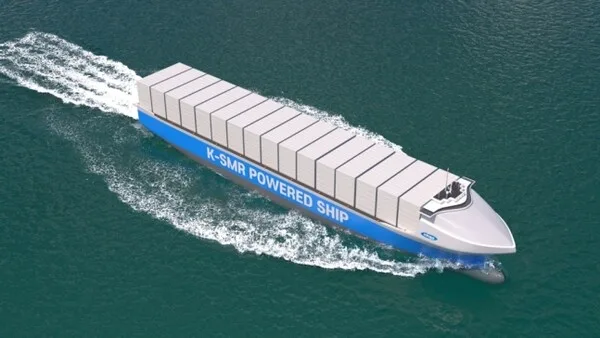
New Nuclear SMR-Powered Ships Project from 2024
KRISO launched a new research program to develop small modular reactors, SMR-powered ships and floating SMR power generation platforms.
Ship Nerd
Miniature Small Modular Reactors (SMRs)
The Miniature Small Modular Reactors (SMRs) are a mini (smaller) version of SMRs, usually compact and scalable, and having a capacity up to 300 MW(e) per unit. They have modular designs, meaning that they can easily be assembled in factories. Some SMRs utilize passive safety systems, and they don’t necessarily require power from external sources and protected against power interruptions.
As a promising solution for green energy in the maritime industry, an SMR named Akademik Lomonosov has been successfully built in Russia since 2020, primarily used as a floating nuclear power plant, with an average power output of 70 MW(e). In 2021, China reportedly connected its HTR-PM to the grid. The HTR-PM is a high-temperature gas-cooled modular reactor. In 2022, the Oregon-headquartered NuScale Power (USA) developed the first SMR model that was approved by the Nuclear Regulatory Commission.
The NuScale’s SMR has a power output of up to 77 MW(e). Similarly, on April 16, 2024, the Korea Research Institute of Ships and Ocean Engineering (KRISO) publicised the launching of a new energy research program for developing core technologies for small modular reactor (SMR)-powered ships and floating SMR power generation, which is scheduled for completion by 2028. Moreover, KRISO is also constructing a high-speed neo-Panamax SMR-Powered container ship (up to 15,000 TEU).
SMRs are considered economical since they do not require large storage tanks such as hydrogen tanks and can systematically reduce radiation emergency around the planning areas.
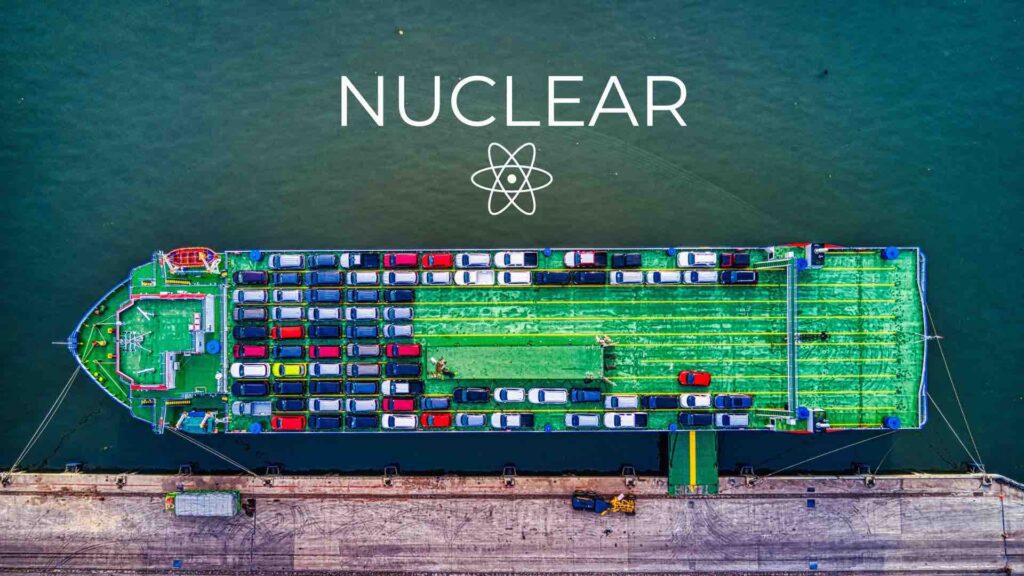
Nuclear Shipping to Solve Climate Change?
Nuclear shipping to solve climate change considering the lack of bunkering infrastructure for many of the alternative fuel options.
Ship Nerd
Molten Salt Reactors (SMRs)
The Molten Salt Reactors (MSRs) are a kind of nuclear fission reactor that uses a molten salt mixture as the coolant and fuel. Unlike traditional reactors that mainly utilize solid fuel rods, MSRs specifically dissolve fissile material like uranium-235 or thorium-232 into liquid salts, ensuring stable fuel circulation and reprocessing.
Maritime experts applaud SMRs’ higher fuel combustion rates, and they are particularly suitable for industrial use owing to their high-temperature output (~700°C), low nuclear waste, and safety. MSRs can be put to a good use as the fuel required for hydrogen generation during green steel production. One major challenge associated with utilizing molten salt reactors is that they can destroy reactor components in the course of time, therefore requiring specialized materials for their replacement. And producing the Molten Salt Reactors (MSRs) in commercial quantity is still practically untenable.
With its TMSR-LF1 reactor, developed in 2023, China is leading the molten salt reactors (MSRs) development globally.
Nuclear Energy Propulsion Potential
It was reported in 2023 that ABS commissioned Herbert Engineering Corp. (HEC) in an innovative study to investigate the apparent impact of nuclear propulsion on the design, operation, and emissions of a 14k TEU container vessel and a 157k DWT Suezmax tanker.
The study modelled the possible effect of two, lead-cooled, 30MW fast reactors on the container carrier, and it discovered that the cargo capacity and operational speed of the vessel will probably increase without necessarily refuelling during its entire 25-year lifespan. However, concerning the Suezmax vessel, the study also indicated that adding four, 5MW, heat-pipe microreactors as the cargo capacity decreases, would subsequently increase operational speeds and refueling may only be required once during its 25-year lifespan. The good news is that both concept vessels would be CO2 emission-free.
The U.S. Department of Energy (DOE) has therefore awarded ABS a contract to research barriers to the adoption of advanced nuclear propulsion on commercial vessels, likewise urging ABS to aid the research being conducted at the University of Texas into the thermal-electric integration of a nuclear propulsion system on a commercial vessel.
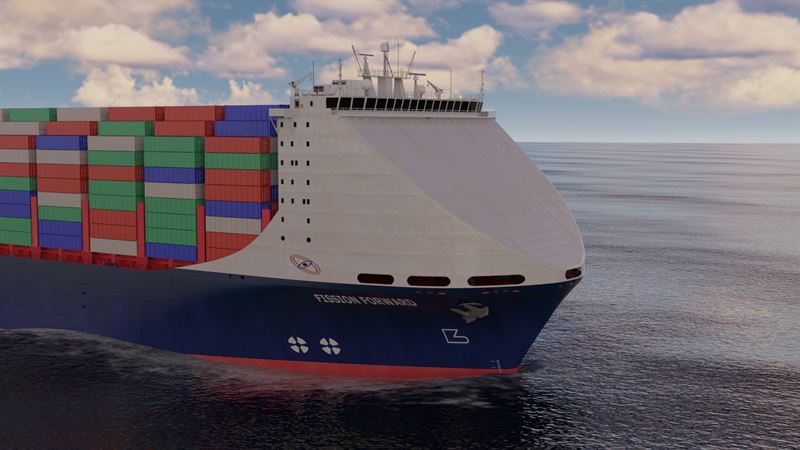
Nuclear Propulsion – New Study on the Potential
Groundbreaking ABS study explores the potential of commercial Nuclear Propulsion application on a container vessel and a tanker.
Ship Nerd
The Need for Technological & Regulatory Adaptations
As new nuclear energy technologies are introduced, the existing ones will have to be modified to meet the functional requirements of the new approaches.
In terms of technological refinement, vessels may be retrofitted to create a space for firmly or securely incorporating Small Modular Reactors (SMRs) within their structures. More importantly, it is imperative that passive cooling systems are implemented in ships to prevent overheating of nuclear materials that may cause harmful radiation and pollution. In the same way, there should an effective onboard fuel and waste management containment on ships that can safely handle low-enriched uranium (LEU) or thorium-based fuels, recycle fuel waste, and reprocess them so as to timely eliminate risks due to nuclear contamination.
Unfortunately, there are currently no globally accepted regulatory framework managing the civil liability of nuclear-powered vessels. This creates chaos and uncertainty about the potential commercialization of nuclear energy for maritime operations. As a matter of fact, a lot of coastal states still regard nuclear power generation illegal. This calls for the enactment of internationally accepted safety standards that touch on important issues such as reactor containment, emergency response processes, and nuclear waste management. [2]
Why Industry Collaboration Is Essential?
As it stands today, getting nuclear energy for ships is expensive and skill-intensive, and port operators may need to collaborate on actualizing this great project. Shippers, shipowners, and port operators will be required to heavily invest in nuclear energy generation, facilitate nuclear fuel supply chain, undertake trainings to fill knowledge gaps among stakeholders, and create rules for mutually beneficial engagements.
There are efforts in certain quarters to develop safety and regulatory guidelines, even though it may take anywhere between 3-5 years before they can be generally adopted, it is important that governments and maritime operators should establish a Nuclear Energy Group that will clearly highlight nuclear energy’s role in modern shipping.
Key Takeaways
The prospect of obtaining nuclear energy, in commercial quantities, for maritime operations is gradually becoming a reality if shippers and port managers take advantage of the clean energy that can be generated via Floating Nuclear Power Plants (FNPPs), Miniature Small Modular Reactors (SMRs), Nuclear Energy Propulsion, and Molten Salt Reactors (MSRs).
See Also

Alternative Fuels Availability for Shipping Industry in 2025
What are the available alternative fuels in 2025? Are shippers determined to reduce GHG emissions to meet their decarbonization goals?