25 October 2026

A Guide for FuelEU Maritime & How to Comply Easily in 2025
A comprehensive guide of FuelEU Maritime essential elements and OPS in order to save Shippers from paying hefty penalties for non-compliance.

The FuelEU Maritime has been in effect since January 2025; this brief guide assists shipowners and ship managers in complying. To summarize:
Fulfilling GHG Intensity Limits: Starting from January 2025, the essence of imposing the Greenhouse Gas (GHG) intensity limit by the FuelEU Maritime is to encourage operators of containerships and passenger ships to fulfil their obligations towards safeguarding the environment.
Having A FuelEU Monitoring Plan: Shipping companies are expected or mandated to have a FuelEU Monitoring Plan before the beginning of the monitoring year.
Understanding the Importance of Onshore Power Supply (OPS): Starting from 1 January 2030, while moored in EU/EEA ports, all containerships and passenger ships will be required to utilize an on-shore power supply (OPS) to generate electricity. The purpose of the OPS is to mobilize shippers to adopt zero-emission technologies such as batteries, fuel cells, wind, or solar power for generating all their electrical power needs while at berth and at sea.
Verification and Compliance Balance: At the conclusion of the monitoring year, precisely by January 31, 2026, and each year thereafter, the shipping companies are mandated to provide details about their the FuelEU Maritime compliance as a report named “the FuelEU Report”, to be submitted to a verifier, also highlighting their efforts towards balancing their GHG intensity limit.
Step-by-Step Guide to Comply: This is a detailed step-by-step guide for shippers who want to avoid penalties when complying with FuelEU Maritime.
Penalties for Not Complying with the Fuel EU: Shipping companies will be subjected to penalties if they fail to comply with the FuelEU Maritime requirements. If the GHG intensity limits for the fuel consumed on board exceed the GHG limit for the year, the shipper will be held responsible for paying a penalty.
Table of Contents
Fulfilling GHG Intensity Limits
The essence of imposing Greenhouse Gas (GHG) intensity limits by the FuelEU Maritime is to encourage shippers to fulfil their obligations towards safeguarding the environment. Beginning in January 2025, to promote the adoption of lower-carbon fuels and renewable energy, the FuelEU Maritime regulations set GHG intensity limits for fuels utilized on board ships over 5,000 GT arriving at or departing from EU/EEA ports. This singular action was taken to also encourage the use of on-shore power supply (OPS) or zero-emission technology in ports primarily handling containerships and passenger ships.
The big picture of the FuelEU Maritime regulations is towards meeting the decarbonization goals by setting a limit for the annual average of “GHG emissions per energy [gCO2eq/MJ]”, often referred to as “GHG intensity”, for certain categories of ships. [1]
Having A FuelEU Monitoring Plan
Shipping companies are expected or mandated to have a FuelEU Monitoring Plan before the beginning of the monitoring year. The FuelEU Monitoring Plan and the FuelEU Report that will follow at the end of the monitoring year must be assessed by a verifier to ascertain that the provisions in the regulation have been successfully fulfilled.
The FuelEU Monitoring Plan, as a matter of fact, must contain the following essential elements or relevant information:
- Ship’s type/name/IMO number/shipowner, and the information of the shipping company;
- Sources of energy to be used on board while in navigation and at berth;
- Procedures for monitoring the fuel consumption of each fuel type;
- Procedures for monitoring the WtT and TtW emission factors of energy to be used;
- Standards and characteristics of OPS or a zero-emission technology; and
- Value of the established total electrical power demand of the ship at berth.
It is imperative that the FuelEU Monitoring Plan must be regularly updated and assessed by the verifier in case there are some changes in the ship ownership (shipping companies), types of fuel used, and so on. [2]
Understanding the Importance of Onshore Power Supply (OPS)
Starting from 1 January 2030, while moored in EU/EEA ports, all containerships and passenger ships will be required to utilize an on-shore power supply (OPS) to generate their power or electricity. Moreover, beginning from 1 January 2035, ships moored at quaysides that are not covered by the ports mentioned above will also be expected to use OPS for their power if they are using ports equipped with OPS systems.
The purpose of utilizing OPS is to mobilize shippers to adopt zero-emission technologies such as batteries, fuel cells, wind, or solar power for generating all their electrical power needs while at berth and at sea. Although ships moored at quayside for less than 2 hours, those that are unable to connect to OPS at ports, or those making unscheduled port calls for safety or life-saving reasons, may be exempted from the penalties for not using OPS as required.
Not complying with the OPS usage will invite a penalty, usually estimated based on the quantity of power consumed during the mooring, which is considered to be non-compliant. [3]
Shore Power Connection – 5 Exciting Reasons to Invest Now
A shore power connection will save fuel and cut your vessel emissions – here are 5 more exciting reasons to invest in ship-to-shore power now!
Ship Nerd
Verification & Compliance Balance
At the conclusion of the monitoring year, precisely by January 31, 2026, and each year thereafter, shipping companies will be required to provide details about their FuelEU Maritime compliance as a report named “the FuelEU Report”. This should contain vital information such as the ship’s departure and arrival ports (indicating the dates and time), the quantity of fuel consumed while at sea and berth, and the amount of electricity provided to the ship through OPS.
Therefore, the verifier will use these important pieces of information to calculate the ship’s annual GHG intensity, amount of yearly energy from the Renewable Fuels of Non-Biological Origin (RFNBO), GHG emissions for the ship for which the GHG intensity was achieved or not achieved, and the number of non-compliant port calls for the use of OPS.
Shipping companies can balance their FuelEU Maritime compliance by engaging in banking or borrowing mechanisms. This entails that surplus compliance (overcompliance) or deficit compliance(undercompliance) can be carried forward or shared among vessels owned by the same or different companies. This practice, popularly known as vessel pooling, lets a shipping company include a ship’s compliance balance in a pool in the FuelEU Maritime database. The pool can comprise of two or more vessels from one or more companies, but one vessel will not be allowed to be part of more than one pool in the same reporting period.
This is How Vessel Pooling Works
A pool is considered valid if the total pooled compliance among the vessels is positive. This means that ships having a compliance deficit before joining the pool must not have a higher compliance deficit after the allocation of the pooled compliance. Similarly, any ship with a compliance surplus must not have a deficit after allocating its compliance balance to the pool. In the foresight, vessel pooling will help shippers limit the amount of investment on FuelEU Maritime compliance and can save their compliance balance for the future. [4]
What is Vessel Pooling? Avoid FuelEU 2025 Penalties
Vessel pooling can support your decarbonisation strategy and help you avoid FuelEU Maritime penalties through renewable and low-carbon fuels.
Ship Nerd
Step-by-Step Guide to Comply
Figure 1.1 below reveals the step-by-step guide for complying with FuelEU Maritime for shippers that want to avoid penalties:
| Aligning stakeholder responsibilities | – Define which parties do what toward achieving the FuelEU compliance (such as GHG intensity tracking, reporting, and surplus management, etc) – The parties may include owners, charterers, and/or managers |
| Assessing and tracking compliance status | – Regularly assessing each vessel’s and the fleet’s GHG intensity relative to the FuelEU targets – Making use of simulation tools to project how a shipper’s compliance status may evolve throughout the year – Considering factors like fuel changes, voyage patterns, and price data |
| Developing a compliance strategy | – Paying the penalty – Purchasing alternative fuels – Borrowing from the following year’s compliance balance |
| Option: Sourcing alternative fuels | – Define which parties do what toward achieving the FuelEU compliance (such as GHG intensity tracking, reporting, and surplus management etc.) – The parties may include owners, charterers, and/or managers |
| Option: Managing external pooling and surplus trading | – Do KYC and partner selection – Maintain data accuracy – Engage in contractual agreements with selected partners – Control oversold compliance surplus |
| Reporting and verifying compliance data and following new compliance requirements | – Look for the corresponding alternative fuel availability and the correct fuel certification for eligibility under FuelEU. – Calculate the exact amount of alternative fuel needed |
Penalties for Not Complying with the Fuel EU
Shipping companies will be subjected to penalties if they fail to comply with the FuelEU Maritime requirements. If the GHG intensity limit for the fuel consumed on board is greater than the GHG limit for the year, the shipper will be held responsible for paying a penalty calculated thus:
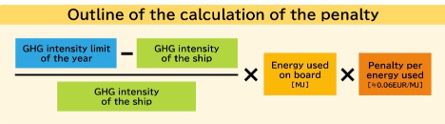
If the outcome of the calculation is negative, the penalty to be paid will be the absolute value of the negative result. If multiple fuels are utilized, the penalty calculation will be based on the weighted average GHG intensity of the fuels used.
If a shipper fails to meet the GHG intensity limit for 2 or more years consecutively, the penalty incurred will be multiplied by 1+(n-1)/10. [6]
Key Takeaways
To avoid paying penalties for FuelEU Maritime non-compliance, shippers should familiarize themselves with the regulation’s step-by-step requirements, implementing every provision in it in order to run a sustainable shipping operation.
See Also
Wind-to-Wake Concept for Shipping Decarbonization
Shipping decarbonization goes beyond the norm. Get up to speed with Wind-to-Wake, the updated method of lifecycle assessment for green fuels.